Console guides
One guide per room of the console: what the room is for, the walk in order with the screens as they are, what it refuses and why, and the page that teaches the capability behind it.
Getting around
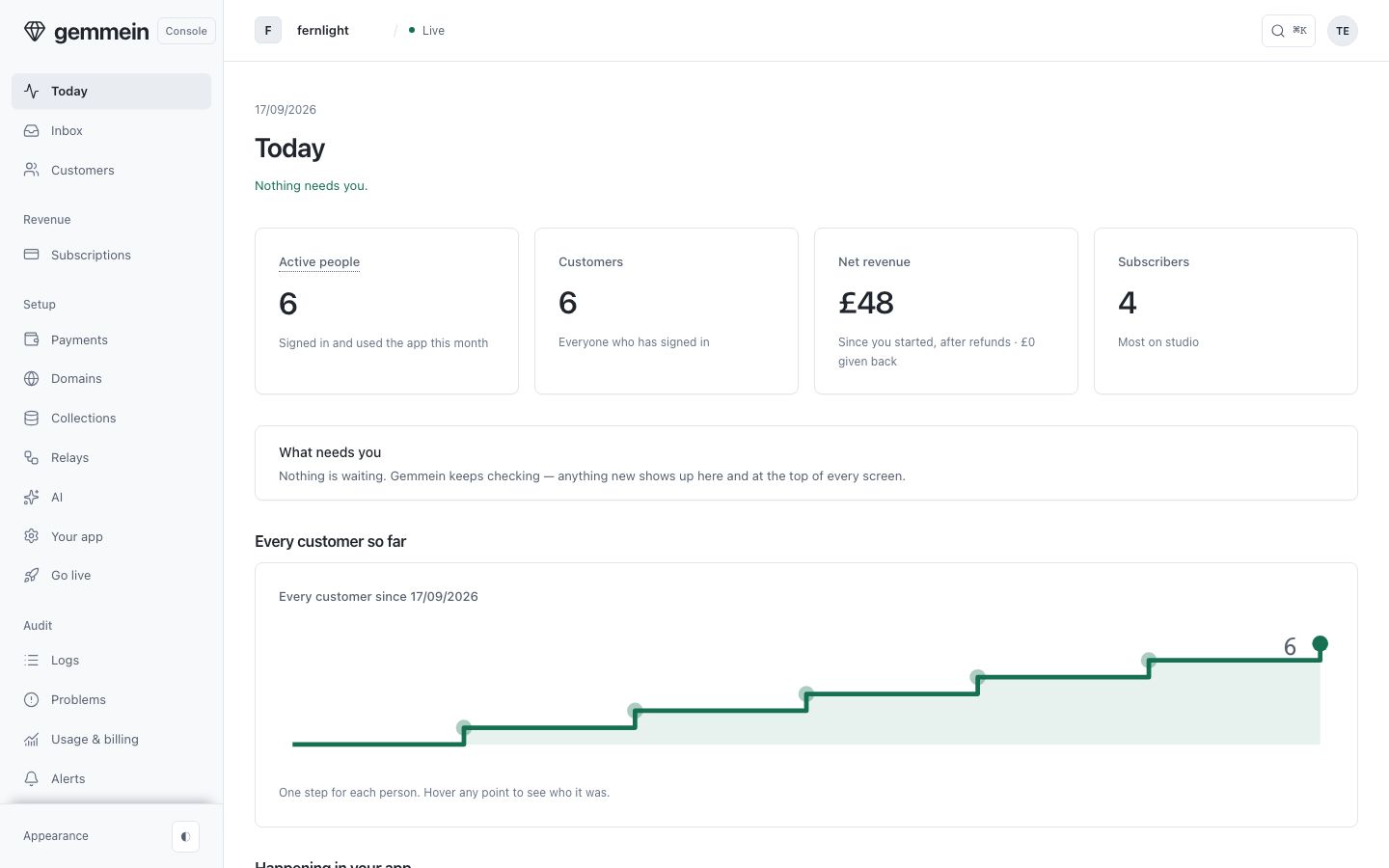
Every room sits behind the same sidebar, the same bar across the top, and the same shape once you're inside.
The sidebar
- Today — the first thing you see: what's left before you go live, then how your app is doing.
- Inbox — the replies your customers send back, and where you answer them.
- Customers — everyone who has signed in, and each person's own page.
- Revenue — who is paying you, for what.
- Setup — payments, your domain, your data, relays, AI, your app's own settings, and going live.
- Audit — what happened, what went wrong, what you're billed, your alerts, and your secret keys.
Today opens first, every time you sign in.
Development and Live
Beside your app's name, a small chip says which one you're looking at. Development is where you build; Live is what your customers use. Turning Development into Live happens on Go live.
Search everywhere
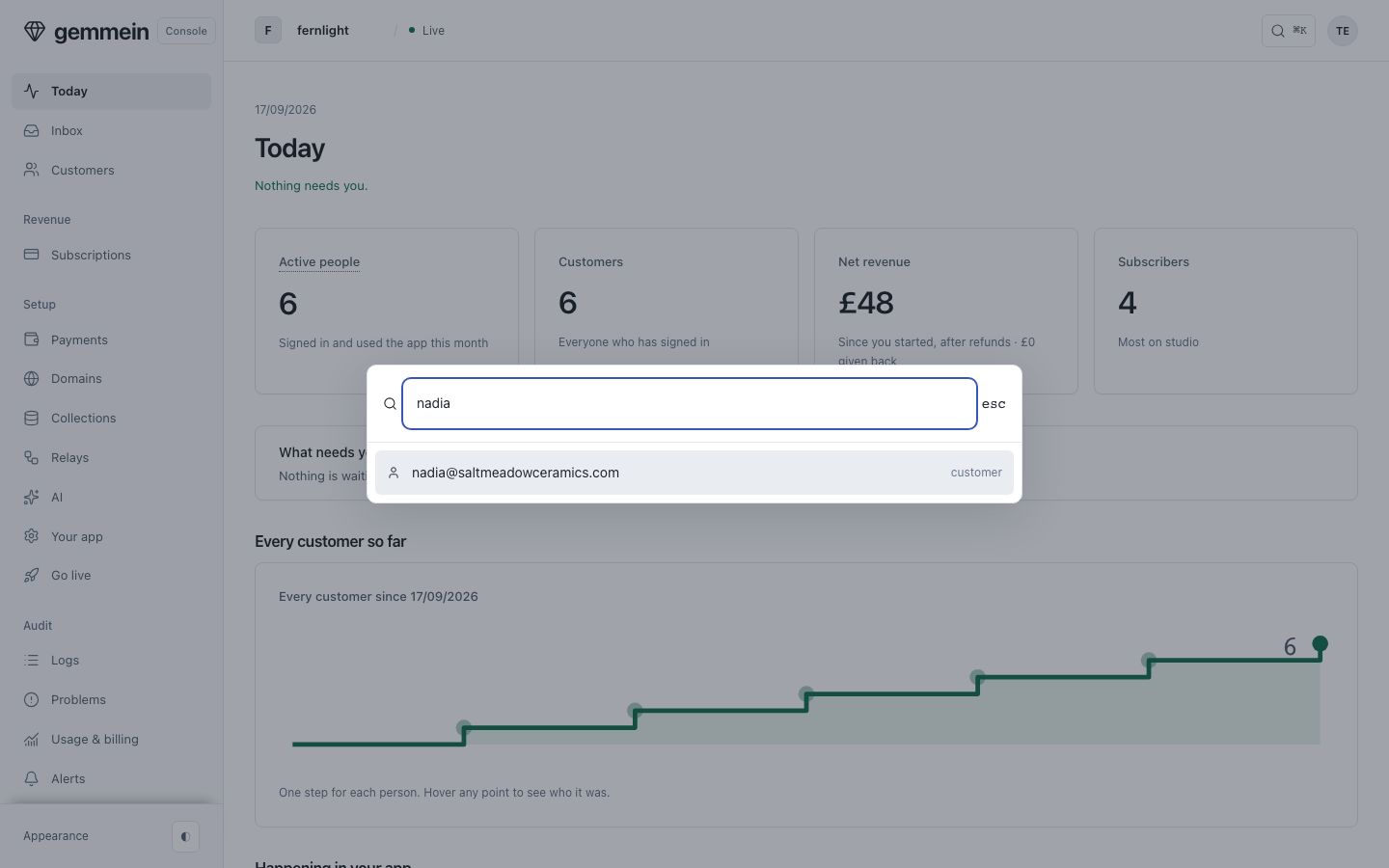
Press ⌘K from anywhere to search the whole console: part of a room's name jumps to it — keys finds Secret keys — and an email finds a customer, or a conversation they sent you. Escape closes it.
Appearance
Your initials, top right, open a short menu: appearance — light or dark — and signing out.
How every room works
Open a room from the sidebar and you land on a list. Choose a row to open its own page, which always starts with a way back to the list. Anything you can do to that row happens on its own page, never in the list. Where the console asks you something, it asks one question per screen, with a strip across the top counting the steps.
On a phone
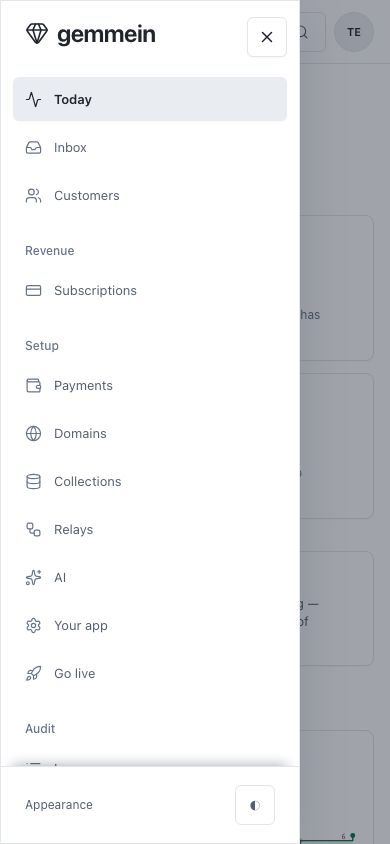
The sidebar becomes a panel behind the menu button, top left.
Rooms
- Today — before launch, what's left and the next step; after, whether anything needs you, how many people use your app and what it's earned.
- AI — provider keys, the tools you price, aliases, runs and calls.
- Records — a collection's rows: search, filter, totals, a record, a new record.
- Relays — a relay from a template, its page and events, editing the definition, pausing.
- Customers — a person's summary, credits (the ledger and a grant), letting them in, what they've done, managing them.
- Payments — plans (how each is sold, credits each period, carry-over), products.
- Secret keys — a server key, its page and usage, rotating and revoking.
- Collections — a collection, its rule, the settings and who unlocks it.
- Subscriptions — who pays for what, a correction, a comp, a cancellation.
- Domains — your web domain and your sending domain, the records, the sender names.
- Your app — the app's name, its keys for the browser and the CLI, the prompt your AI reads.
- Go live — what, if anything, is left, and what goes live with your app; once live, where what you build in development reaches it.
- Logs — who did what, in your app and on your account.
- Problems — your live app's mistakes: every write Gemmein refused, grouped by what went wrong, with the exact refusal your app was told.
- Alerts — what Gemmein tells you about, and where.
- Inbox — the other half of the email your app sends: a customer's reply lands here, your answer goes back from your own sender.
- Usage & billing — what Gemmein costs you: your active people, the band your bill follows once you're live, and holding that band.
The docs teach what the engine does; a guide shows how a room is used. Every guide ends with a link to the docs page for its capability, never a copy of it.